
“The next 25 years of the web will be all about design.” — Vlad Magdalin, 2014
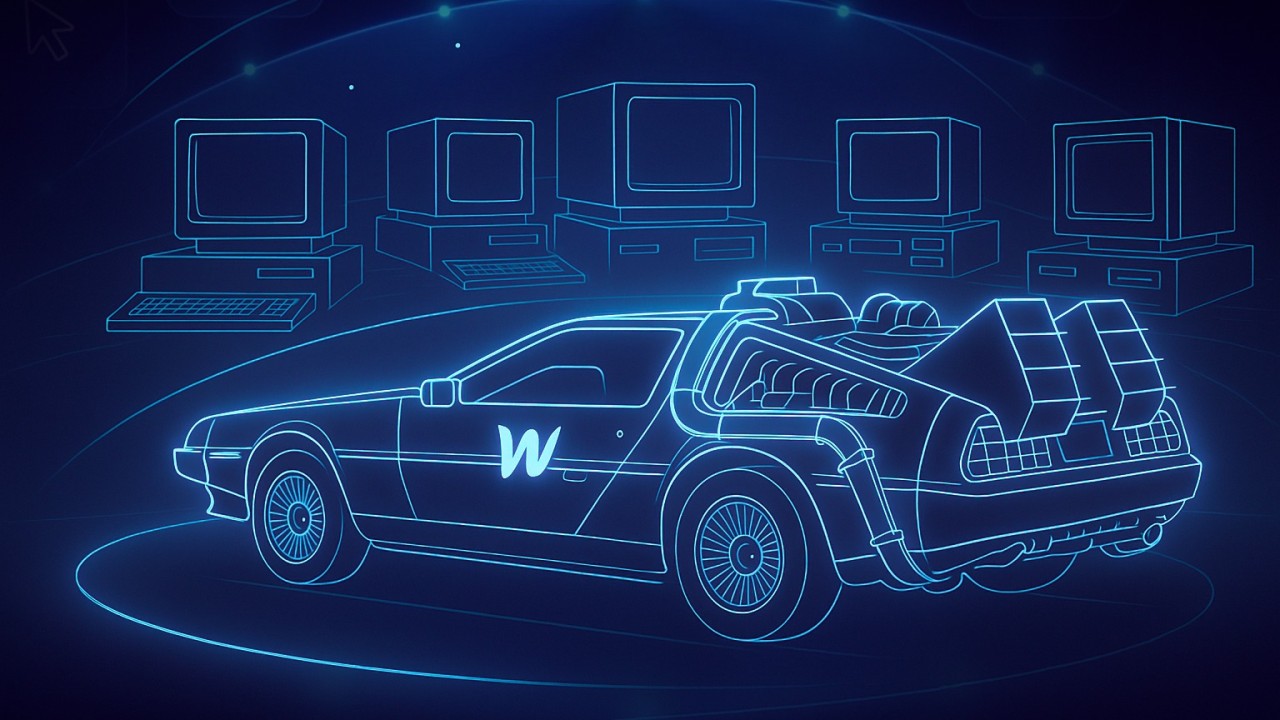
I reread Vlad Magdalin earliest Webflow blog post and switched on a “time machine.” This is a thank-you to the fathers of visual web creation and the internet’s early pioneers. Below: a concise chronicle of Webflow’s “great-grandfather” (iBand Backstage), two portraits ( Anthony J. Wood and Vlad Magdalin ), and a look ahead at AI’s role and what’s next.
Snapshot: iBand → Backstage → Macromedia acquisition → Dreamweaver
- iBand Inc. (Campbell, CA) built the Backstage family—visual web tools aimed not only at page authoring but also at dynamic, data-driven experiences. In March 1996, Macromedia, Inc. acquired iBand (contemporary reports cite ~$32–36M in stock). iBand’s founder Anthony J. Wood became VP of Internet Authoring at Macromedia, Inc. .
- On parts of the Backstage codebase, Macromedia, Inc. developed Dreamweaver (first release in 1997). A defining feature was Roundtrip HTML—visual edits that don’t trash clean, hand-written code. That bridge reconciled designers and developers: visual speed and professional control.
- Context: in January 1996, Microsoft bought Vermeer/FrontPage, staking a WYSIWYG claim inside the Windows ecosystem.
Takeaway: Backstage gave Dreamweaver its DNA—balancing visual velocity with code fidelity. That became the norm for the next generation of tools.
Two portraits — two lines of the same story
Anthony J. Wood Engineer-entrepreneur: founded iBand (1995), sold it to Macromedia (1996), briefly ran Internet Authoring there, then left ~18 months later to found ReplayTV, and later Roku. His arc underlines a point: the 90s deals were often about technology and teams, not personalities. The asset wasn’t a single “star,” but the IP and the people who could ship.
Vlad Magdalin In 2014, Vlad framed the mission: open web creation to designers with no compromise on quality and performance. Later he broadened it: not just designers—anyone should be able to harness the web. That’s not a slogan; it’s a product strategy that shaped what Webflow can do today.
About culture: Webflow consistently centers empathy for creators. You feel it in talks, events, even the music and performance moments on stage—less “corporate,” more community of makers.
The “great-grandfather” of Webflow: what Backstage/Dreamweaver taught us
- Visual speed must not kill code. Roundtrip HTML became the bridge: edit visually, keep the markup sane.
- Dynamic web is the default. Early editors thought in pages; Backstage already leaned toward interactivity and data.
- Teams outlive names. iBand’s engineers rarely appear in the archives, yet their decisions echo in every generation of tools.
Today: what Webflow already offers product & enterprise teams
- Analyze — native analytics inside Webflow: auto-captured key events, click maps, goals. Faster answers without a tracking zoo.
- Optimize — experiments and personalization (A/B tests, segments, AI-assisted optimization) built into the platform.
- Governance & security (Enterprise): Audit logs, roles/permissions (including custom roles), SSO, activity logs. This is about control, auditability, and scale.
Philosophically, all of this continues the same idea: give creators speed without losing control.
Tomorrow: Code Components — the bridge to complex interfaces
In 2025, Webflow announced Code Components: bring React components (via DevLink) into the Designer with props/slots, CMS/localization bindings, versioning—code-authored components behave like native building blocks. That removes the historic gap between visual canvas and engineering.
Next on the path: WebGL/Canvas widgets through the same bridge; AI assistants for “starter” components and auto-layout. The principle stays: the system handles complexity; the human sets the meaning.
My Serhii Havryliuk craftsman’s take
A designer is an architect of meaning. They set the story, rhythm, and tone—while the system ( Webflow + Code Components + Optimize + Analyze) delivers speed, control, and measurable outcomes.
Interfaces, like people, have a voice and hearing. Voice is content and visual language. Hearing is feedback. Optimize and Analyze give this “organism” ears and memory: we hear where users nod, go silent, or drop off—and we learn to speak more clearly, more human.
Code Components are the “hands” that take on the hard things: React logic, WebGL, atypical widgets. But the heart stays human. AI removes routine, not empathy. It doesn’t replace taste; it integrates into the craft.
Practical checklist for a B2B/Enterprise site on Webflow (human-first)
- One core idea per screen. Each block answers one client question and moves to one action.
- A story, not a parts list. Who you are, what changes for the client, what happens after the click—plain language.
- Components as a system, not “magic.” Reusables live in Libraries; special cases in Code Components. Scale without chaos.
- Frictionless forms. One idea per step, minimal fields, honest hints.
- Three metrics, not thirty. Define success now (e.g., demo starts / qualified leads / activation). The rest is noise.
- Small experiments → fast calls. In Optimize, test one hypothesis at a time and record the decision: keep / remove / rework.
- Speed & accessibility by default. Lightweight front end, clear contrast, keyboard navigation—respect for users and your budget.
- Order & safety. Roles, pre-publish reviews, change audits (audit logs/activity). A calmer product, a faster team.
A little sentiment and optimism
We stand on the shoulders of people whose names rarely make the cover: the iBand engineers, the Backstage team, the minds behind Roundtrip HTML, and everyone who believed visual speed and clean code could coexist. Later, Vlad Magdalin and the Webflow team gave that belief clear words—and product.
What’s next looks even better. AI becomes the apprentice in the studio, sanding the routine and suggesting options. The master remains human: hearing context, feeling brand tone, and shaping experiences people want to return to.
Sources & further reading
- Vlad Magdalin , “Designers will rule the web” (2014): webflow.com/blog/designers-will-rule-the-web
- Historical coverage of the iBand acquisition by Macromedia (1996) and the emergence of Dreamweaver / Roundtrip HTML (1997–1998).
- Webflow product docs and announcements for Analyze, Optimize, Enterprise governance, and Code Components/DevLink (2024–2025).
Author & contact (honestly, by tradition)
If you’d like to apply these principles to your product (React components on Webflow’s canvas, clean experiments and personalization, transparent governance), here’s the easiest way to reach me:
Serhii Havryliuk (Webflowich) — Webflow Premium Partner → Partner Profile
P.S. Adding this link not as a pitch, but as a practical path to a conversation—because that’s the tradition with pieces like this.